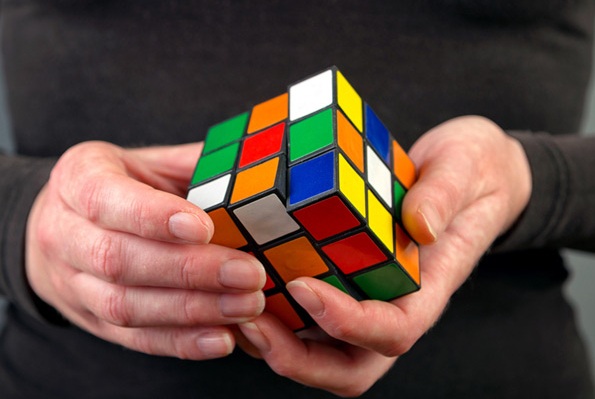
The Rubik’s Cube is a puzzle that has fascinated and frustrated people for decades. What seems like an impossible jumble of colors can be organized into a perfect, solved state. Many believe you need to be a genius to accomplish this feat, but that’s not true. With the right method and a little practicing, anyone can learn how to solve a Rubik’s Cube.
This comprehensive guide will walk you through the most popular beginner’s method, breaking it down into manageable steps. We will cover everything from understanding the cube’s basic mechanics to learning the simple algorithms needed to complete the puzzle. This isn’t a trick on how to solve a Rubik’s Cube in 10 moves, but a legitimate strategy that builds your skills. By the end, you’ll not only have a completed cube but also the knowledge to do it again and again. This tutorial is designed to be simple enough to work as a guide on how to solve a Rubik’s cube for kids and adults alike.
Understanding Your Rubik’s Cube
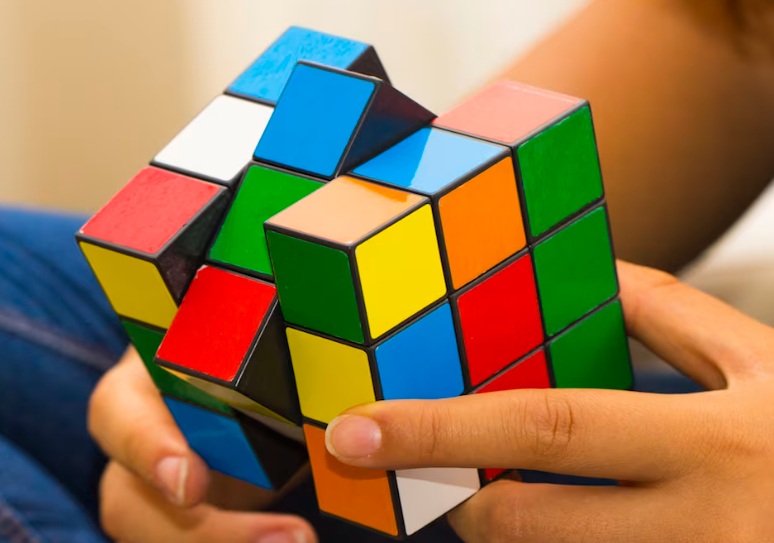
Before we dive into the solution, it’s crucial to understand the puzzle itself. A standard 3×3 Rubik’s Cube isn’t just a collection of 54 stickers; it’s made of 26 smaller cubes, or “cubies.”
The Anatomy of the Cube
The cube is composed of three types of pieces:
- Centre Pieces (6): These are the single-colored pieces in the middle of each face. A key fact is that the centre pieces don’t move in relation to each other. The white center is always opposite the yellow, blue is opposite green, and red is opposite orange. This is your anchor.
- Edge Pieces (12): These pieces have two colors (two stickers). They are located between the centre pieces.
- Corner Pieces (8): These pieces have three colors (three stickers) and are found at the corners of the cube.
Understanding this structure is fundamental. You are not moving stickers around; you are moving these 20 pieces (12 edges and 8 corners) into their correct positions. The goal is to solve the cube layer by layer, not one face at a time. This is a core principle for anyone learning how to solve a Rubik’s Cube.
Learning the Notation
To solve the cube, we use a series of moves called algorithms. These are described using a simple notation system. Each letter corresponds to a face of the cube:
- F: Front face (the one facing you)
- B: Back face
- U: Up face
- D: Down face
- L: Left face
- R: Right face
A letter by itself means you rotate that face 90 degrees clockwise. An apostrophe ( ‘ ) after a letter (e.g., R’) means you turn it 90 degrees anticlockwise. A “2” after a letter (e.g., U2) means you turn it 180 degrees. Learning this notation is essential for any Rubik’s cube solver.
The 7 Steps to Solve a Rubik’s Cube
This guide breaks down the process into seven main steps. We will start with the white face and work our way up. It’s a good habit to always start with the same color to build consistency.
Step 1: Create the White Cross
The first goal is to create a white cross on the Up face. But it’s not just any cross. The edge pieces of the cross must also line up with the centre pieces of the adjacent faces.
Finding the Edge Pieces
- Hold the cube with the white centre piece facing up.
- Look for the four white edge pieces. They might be on the top layer, bottom layer, or in the middle layer.
- Your task is to move each white edge piece into the top layer so that its other color matches the adjacent centre piece. For example, the white-blue edge piece should be between the white and blue centre pieces.
This step relies mostly on logic and intuition. Try to solve this part on your own first. If an edge piece is in the correct spot but flipped the wrong way, move it to the bottom layer, orient it correctly, and then move it back up. Mastering this initial step is a big part of learning how to solve a Rubik’s Cube.
Step 2: Solve the White Corners
With the white cross complete, the next step is to solve the four white corner pieces. When you’re done, the entire white face will be solved, and the colors on the side of that layer will match their respective centers, completing the first layer.
Placing the Corners
- Find a corner piece that has white on it in the bottom layer. For example, the white-red-blue corner.
- Rotate the bottom layer (D or D’) until that corner is directly underneath where it needs to go (between the red and blue centers).
- Depending on which way the white sticker is facing, you will use a short algorithm.
- If white faces right: R’ D’ R
- If white faces front: F D F’
- If white faces down: R’ D2 R D R’ D’ R
- Repeat this process for all four corners. If a white corner is stuck in the top layer but in the wrong spot, use one of the same algorithms to take it out, which will move it to the bottom layer.
Step 3: Solve the Second Layer
Congratulations! The first layer is done. Now, turn the cube upside-down, so the white face is on the bottom. The yellow centre should now be on top. Our goal is to place the four edge pieces that belong in the middle layer.
Inserting the Middle Layer Edges
- Look for an edge piece in the top (yellow) layer that does not have yellow on it. For instance, the red-blue edge.
- Rotate the Up face (U) to line up the edge’s front-facing color with its corresponding centre piece, forming an upside-down “T”.
- Now, determine if this piece needs to go to the right or the left to fit into the middle layer.
- To move the piece to the Right: U R U’ R’ U’ F’ U F
- To move the piece to the Left: U’ L’ U L U F U’ F’
- Repeat this for all four middle layer edges. If an edge piece is in the middle layer but in the wrong spot or flipped, use one of the algorithms to insert a different piece into its spot. This will pop the incorrect piece out into the top layer, and you can then solve it correctly. This is a critical part of the process to solve Rubik’s cube 3×3.
Step 4: Create the Yellow Cross (Last Layer Cross)
Now we focus on the last layer. The first task here is to form a cross on the yellow face. Don’t worry about the edge colors matching the side centers yet. You will have one of four patterns on the yellow face:
- A “dot” (just the yellow centre).
- A backwards “L” shape.
- A horizontal “line”.
- A cross (already solved!).
Hold the cube to match one of the descriptions below and perform the algorithm.
- If you have the “dot”: Perform F R U R’ U’ F’. This will give you the “L” shape.
- If you have the “L” shape: Orient the cube so the “L” is in the top-left corner. Perform F R U R’ U’ F’. This will create the “line”.
- If you have the “line”: Orient the cube so the line is horizontal. Perform F R U R’ U’ F’. This will complete your yellow cross.
Step 5: Position the Last Layer Edges
Your yellow cross is done. The next step is to arrange the yellow edge pieces so their other colors match the side centre pieces.
- Rotate the Up face (U) until at least two of the yellow edge pieces are in their correct spots.
- You will have one of two situations:
- The two correct edges are adjacent to each other.
- The two correct edges are opposite each other.
- If they are adjacent: Hold the cube so the two correct edges are at the Back and Right faces. Perform this algorithm: R U R’ U R U2 R’. After one final U turn, all four edges should be correct.
- If they are opposite: Hold the cube so the correct edges are at the Front and Back faces. Perform the same algorithm: R U R’ U R U2 R’. This will result in two adjacent edges being correct. Now, simply perform the step for the adjacent case above.
This part of learning how to solve a Rubik’s cube requires careful observation.
Step 6: Position the Last Layer Corners
Only the corners of the last layer remain. First, we need to get the corner pieces into their correct positions, even if they are not oriented correctly (twisted).
- Examine the cube and find a corner piece that is already in the right place. A corner is “correct” if its three colors match the three adjacent centre pieces.
- If you have one correct corner, hold the cube so this piece is in the front-right-up position (the FRU corner). Then, perform this algorithm: U R U’ L’ U R’ U’ L. This sequence swaps the other three corners. You may need to do it twice.
- If no corners are in the right place, perform the algorithm from any angle. This will move at least one corner into the correct position. Then, proceed as described above.
Step 7: Orient the Last Layer Corners (The Final Step!)
This is it, the last step to finally solve the Rubik’s cube 3×3! Here, we will orient the remaining yellow corners to complete the cube.
- Hold the cube with the yellow face up. Find an incorrectly oriented corner and rotate the Up face to bring it to the front-right-up position (FRU corner).
- Now, repeat the following short algorithm until that specific corner piece is correctly oriented with yellow facing up: (R’ D’ R D).
- This is the most important part: While performing this algorithm, the bottom two layers will get scrambled. Do not panic! Keep repeating the sequence until the yellow sticker of that single corner is on top. It will take either two or four repetitions.
- Once that corner is solved, do not rotate the whole cube. Instead, keep your grip and only turn the Up face (U or U’) to bring the next unsolved corner into the FRU corner spot.
- Repeat the (R’ D’ R D) sequence on this new corner until it is also solved.
- Continue this process until all corners are oriented. When the last corner is fixed, the bottom layers will magically resolve themselves. A final turn of the Up face will align all the colors.
Congratulations! You have just learned how to solve a Rubik’s Cube!
Practice and Next Steps
You’ve completed the puzzle, but the journey doesn’t have to end. The key to getting faster is practicing. The more you solve it, the more the algorithms will become muscle memory. Your first solve might take a while, but soon you’ll be solving it in minutes. You’ve mastered the beginner’s method, which is a fantastic achievement. This forms the foundation for more advanced techniques if you wish to pursue speedcubing.
| Step | Goal | Key Algorithm |
| 1 | The White Cross | Intuitive |
| 2 | The White Corners | R’ D’ R |
| 3 | The Second Layer | U R U’ R’ U’ F’ U F |
| 4 | The Yellow Cross | F R U R’ U’ F’ |
| 5 | Position Yellow Edges | R U R’ U R U2 R’ |
| 6 | Position Yellow Corners | U R U’ L’ U R’ U’ L |
| 7 | Orient Yellow Corners | R’ D’ R D |
Frequently Asked Questions (FAQs)
- How long does it take to learn how to solve a Rubix Cube?
With a good guide like this one, you can learn the basics and complete your first solve in a few hours. Getting fast, however, comes with practicing. Most people can get their time down to under two minutes within a few weeks. - Is there a way to solve a Rubik’s Cube in 10 moves?
From any scrambled state? No. The idea of how to solve a Rubik’s cube in 10 moves is a myth. The maximum number of moves required to solve any scramble (known as “God’s Number”) is 20, but those solutions require incredibly complex algorithms and are not humanly feasible to find on the fly. - What is the best method for kids to learn?
The beginner’s layer-by-layer method detailed in this article is perfect for teaching how to solve a Rubik’s Cube for kids. It breaks the puzzle into simple, logical steps with easy-to-memorize algorithms. - My cube seems impossible to solve. What’s wrong?
Occasionally, a cube can be in an “unsolvable” state. This happens if the cube was taken apart and reassembled incorrectly, or if a sticker was peeled off and moved. The most common sign is having only one edge piece or one corner piece flipped incorrectly in the last layer. The only solution is to carefully twist a corner or pop an edge piece out and put it back in the right way. - What is a Rubik’s Cube solver?
A Rubik’s Cube solver can refer to a person who solves the cube, or more commonly, an online tool or app that can generate a solution for you. You input the current state of your scrambled cube by matching the colors, and the program will output the exact sequence of moves to solve it. While useful, learning how to solve a Rubik’s Cube yourself is far more rewarding.

